Tuesday, 26 June 2012

Speed Interview with Ellie Nugent

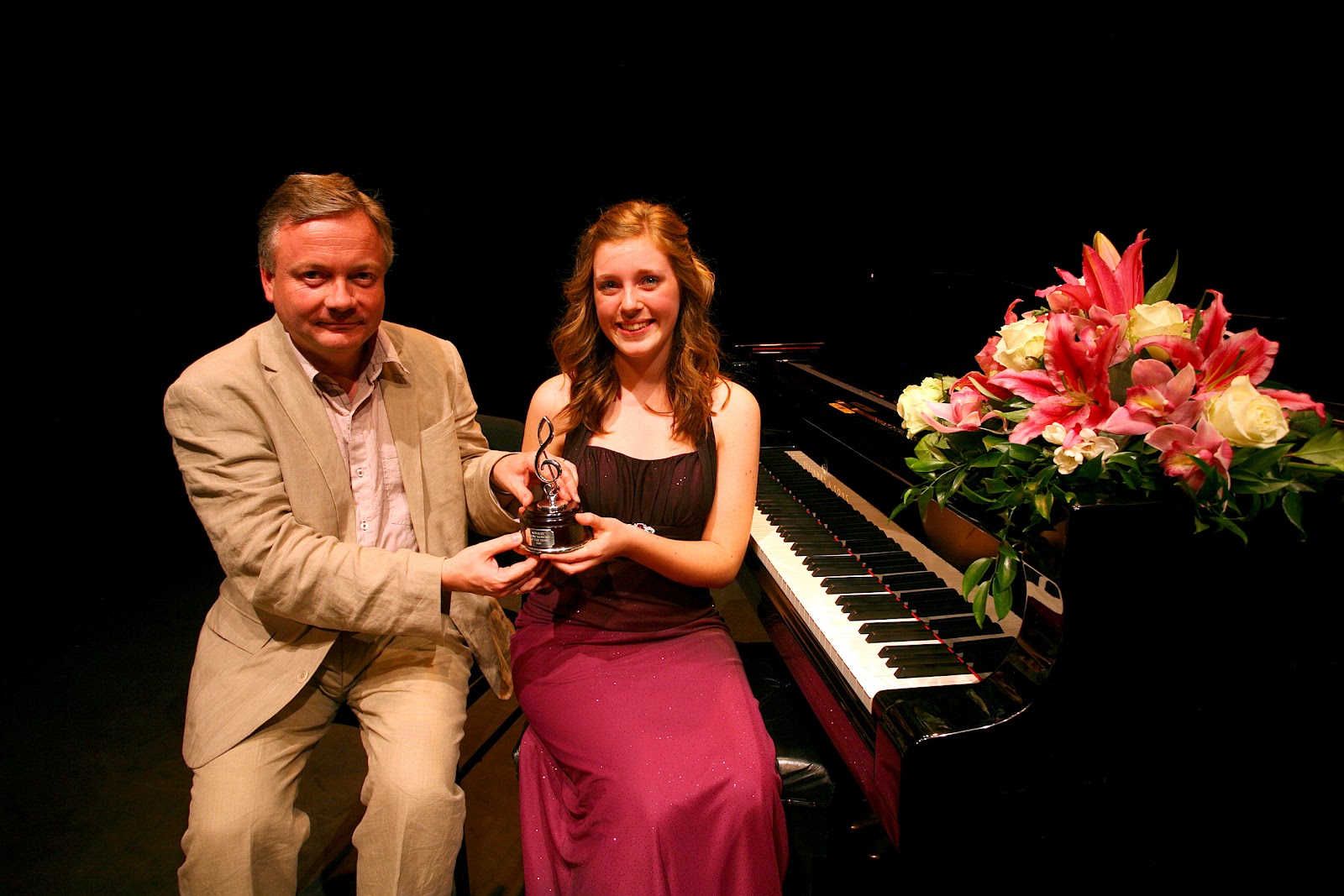
As you may know, at Southern Sinfonia we remain in close contact with as many of our Newbury Young Musician of the Year finalists as possible. The final for our 2012 competition took place on Sunday 24 June (for more information please see the website) and we were very pleased to be able to catch up with our 2010 champion Ellie Nugent. Here's a quick interview with her:

So what have you been up to since you performed Nielsen's Flute Concerto with us?
Well, I've just taken my A levels, so i've been revising for those all the time. Although I'm looking forward to getting some more music in over the summer.

What A-Levels did you take?
I took Law, German and Music. I'm hoping to go to New College, Oxford to study Music, so i'm keeping my fingers crossed for my results in August.

Are you looking forward to your Prom with the National Youth Orchestra of Great Britain?
Yes, I'm really looking forward to that! I'll be playing the piccolo I bought with my prize money from Newbury Young Musician of the Year, so that will be great. The programme features a new piece by Nico Muhly, Varèse's Tuning Up and Messiaen's Turangalîla Symphony, so it really is a great opportunity.

For more information about the National Youth Orchestra of Great Britain's Prom please click here.

Have you got any plans for the holidays?
Yes, I'm playing the piano in a production of West Side Story by RicNic Oxford at the Pegasus Theatre and I'm also attending the British Flute Society's International Convention in Manchester, so it's going to be a busy summer!


Monday, 18 June 2012

A Sea Symphony...In Context (4)


Howard Hodgkin - Indian View J
The finale of RVW's A Sea Symphony, The Explorers, is the most ambitious and moving section of the symphony and is heavily indebted to Elgar’s Dream of Gerontius. Here, for the audience at least, the end of the voyage approaches, with the music gradually receding like a ship disappearing over the horizon. Vaughan Williams used sections of Walt Whitman’s Passage to India for this final movement. So here’s the poem in its entirety, with the sections Vaughan Williams used in bold.


Passage to India
By Walt Whitman
 
  1
Singing my days,
Singing the great achievements of the present,
Singing the strong light works of engineers,
Our modern wonders, (the antique ponderous Seven outvied,)
In the Old World the east the Suez canal,
The New by its mighty railroad spann'd,
The seas inlaid with eloquent gentle wires;
Yet first to sound, and ever sound, the cry with thee O soul,
The Past! the Past! the Past!

The Past—the dark unfathom'd retrospect!
The teeming gulf—the sleepers and the shadows!
The past—the infinite greatness of the past!
For what is the present after all but a growth out of the past?
(As a projectile form'd, impell'd, passing a certain line, still keeps on,
So the present, utterly form'd, impell'd by the past.)

      2
Passage O soul to India!
Eclaircise the myths Asiatic, the primitive fables.
Not you alone proud truths of the world,
Nor you alone ye facts of modern science,
But myths and fables of eld, Asia's, Africa's fables,
The far-darting beams of the spirit, the unloos'd dreams,
The deep diving bibles and legends,
The daring plots of the poets, the elder religions;
O you temples fairer than lilies pour'd over by the rising sun!
O you fables spurning the known, eluding the hold of the known,
      mounting to heaven!
You lofty and dazzling towers, pinnacled, red as roses, burnish'd
      with gold!
Towers of fables immortal fashion'd from mortal dreams!
You too I welcome and fully the same as the rest!
You too with joy I sing.

Passage to India!
Lo, soul, seest thou not God's purpose from the first?
The earth to be spann'd, connected by network,
The races, neighbors, to marry and be given in marriage,
The oceans to be cross'd, the distant brought near,
The lands to be welded together.

A worship new I sing,
You captains, voyagers, explorers, yours,
You engineers, you architects, machinists, yours,
You, not for trade or transportation only,
But in God's name, and for thy sake O soul.

      3
Passage to India!
Lo soul for thee of tableaus twain,
I see in one the Suez canal initiated, open'd,
I see the procession of steamships, the Empress Engenie's leading the van,
I mark from on deck the strange landscape, the pure sky, the level
      sand in the distance,
I pass swiftly the picturesque groups, the workmen gather'd,
The gigantic dredging machines.

In one again, different, (yet thine, all thine, O soul, the same,)
I see over my own continent the Pacific railroad surmounting every barrier,
I see continual trains of cars winding along the Platte carrying
      freight and passengers,
I hear the locomotives rushing and roaring, and the shrill steam-whistle,
I hear the echoes reverberate through the grandest scenery in the world,
I cross the Laramie plains, I note the rocks in grotesque shapes,
      the buttes,
I see the plentiful larkspur and wild onions, the barren, colorless,
      sage-deserts,
I see in glimpses afar or towering immediately above me the great
      mountains, I see the Wind river and the Wahsatch mountains,
I see the Monument mountain and the Eagle's Nest, I pass the
      Promontory, I ascend the Nevadas,
I scan the noble Elk mountain and wind around its base,
I see the Humboldt range, I thread the valley and cross the river,
I see the clear waters of lake Tahoe, I see forests of majestic pines,
Or crossing the great desert, the alkaline plains, I behold
      enchanting mirages of waters and meadows,
Marking through these and after all, in duplicate slender lines,
Bridging the three or four thousand miles of land travel,
Tying the Eastern to the Western sea,
The road between Europe and Asia.

(Ah Genoese thy dream! thy dream!
Centuries after thou art laid in thy grave,
The shore thou foundest verifies thy dream.)

      4
Passage to India!
Struggles of many a captain, tales of many a sailor dead,
Over my mood stealing and spreading they come,
Like clouds and cloudlets in the unreach'd sky.

Along all history, down the slopes,
As a rivulet running, sinking now, and now again to the surface rising,
A ceaseless thought, a varied train—lo, soul, to thee, thy sight,
      they rise,
The plans, the voyages again, the expeditions;
Again Vasco de Gama sails forth,
Again the knowledge gain'd, the mariner's compass,
Lands found and nations born, thou born America,
For purpose vast, man's long probation fill'd,
Thou rondure of the world at last accomplish'd.

      5
O vast Rondure, swimming in space,
Cover'd all over with visible power and beauty,
Alternate light and day and the teeming spiritual darkness,
Unspeakable high processions of sun and moon and countless stars above,
Below, the manifold grass and waters, animals, mountains, trees,
With inscrutable purpose, some hidden prophetic intention,
Now first it seems my thought begins to span thee.
 
Down from the gardens of Asia descending radiating,
Adam and Eve appear, then their myriad progeny after them,
Wandering, yearning, curious, with restless explorations,
With questionings, baffled, formless, feverish, with never-happy hearts,
With that sad incessant refrain, Wherefore unsatisfied soul? and
      Whither O mocking life?

Ah who shall soothe these feverish children?
Who Justify these restless explorations?
Who speak the secret of impassive earth?
Who bind it to us? what is this separate Nature so unnatural?
What is this earth to our affections? (unloving earth, without a
      throb to answer ours,
Cold earth, the place of graves.)

Yet soul be sure the first intent remains, and shall be carried out,
Perhaps even now the time has arrived.

After the seas are all cross'd, (as they seem already cross'd,)
After the great captains and engineers have accomplish'd their work,
After the noble inventors, after the scientists, the chemist, the
      geologist, ethnologist,
Finally shall come the poet worthy that name,
The true son of God shall come singing his songs.

Then not your deeds only O voyagers, O scientists and inventors,
      shall be justified,
All these hearts as of fretted children shall be sooth'd,
All affection shall be fully responded to, the secret shall be told,
All these separations and gaps shall be taken up and hook'd and
      link'd together,
The whole earth, this cold, impassive, voiceless earth, shall be
      completely Justified,
Trinitas divine shall be gloriously accomplish'd and compacted by
      the true son of God, the poet,
(He shall indeed pass the straits and conquer the mountains,
He shall double the cape of Good Hope to some purpose,)
Nature and Man shall be disjoin'd and diffused no more,
The true son of God shall absolutely fuse them.

      6
Year at whose wide-flung door I sing!
Year of the purpose accomplish'd!
Year of the marriage of continents, climates and oceans!
(No mere doge of Venice now wedding the Adriatic,)
I see O year in you the vast terraqueous globe given and giving all,
Europe to Asia, Africa join'd, and they to the New World,
The lands, geographies, dancing before you, holding a festival garland,
As brides and bridegrooms hand in hand.

Passage to India!
Cooling airs from Caucasus far, soothing cradle of man,
The river Euphrates flowing, the past lit up again.

Lo soul, the retrospect brought forward,
The old, most populous, wealthiest of earth's lands,
The streams of the Indus and the Ganges and their many affluents,
(I my shores of America walking to-day behold, resuming all,)
The tale of Alexander on his warlike marches suddenly dying,
On one side China and on the other side Persia and Arabia,
To the south the great seas and the bay of Bengal,
The flowing literatures, tremendous epics, religions, castes,
Old occult Brahma interminably far back, the tender and junior Buddha,
Central and southern empires and all their belongings, possessors,
The wars of Tamerlane,the reign of Aurungzebe,
The traders, rulers, explorers, Moslems, Venetians, Byzantium, the
      Arabs, Portuguese,
The first travelers famous yet, Marco Polo, Batouta the Moor,
Doubts to be solv'd, the map incognita, blanks to be fill'd,
The foot of man unstay'd, the hands never at rest,
Thyself O soul that will not brook a challenge.

The mediaeval navigators rise before me,
The world of 1492, with its awaken'd enterprise,
Something swelling in humanity now like the sap of the earth in spring,
The sunset splendor of chivalry declining.

And who art thou sad shade?
Gigantic, visionary, thyself a visionary,
With majestic limbs and pious beaming eyes,
Spreading around with every look of thine a golden world,
Enhuing it with gorgeous hues.

As the chief histrion,
Down to the footlights walks in some great scena,
Dominating the rest I see the Admiral himself,
(History's type of courage, action, faith,)
Behold him sail from Palos leading his little fleet,
His voyage behold, his return, his great fame,
His misfortunes, calumniators, behold him a prisoner, chain'd,
Behold his dejection, poverty, death.

(Curious in time I stand, noting the efforts of heroes,
Is the deferment long? bitter the slander, poverty, death?
Lies the seed unreck'd for centuries in the ground? lo, to God's due
      occasion,
Uprising in the night, it sprouts, blooms,
And fills the earth with use and beauty.)

      7
Passage indeed O soul to primal thought,
Not lands and seas alone, thy own clear freshness,
The young maturity of brood and bloom,
To realms of budding bibles.

O soul, repressless, I with thee and thou with me,
Thy circumnavigation of the world begin,
Of man, the voyage of his mind's return,
To reason's early paradise,
Back, back to wisdom's birth, to innocent intuitions,
Again with fair creation.

      8
O we can wait no longer,
We too take ship O soul,
Joyous we too launch out on trackless seas,
Fearless for unknown shores on waves of ecstasy to sail,
Amid the wafting winds, (thou pressing me to thee, I thee to me, O soul,)
Caroling free, singing our song of God,
Chanting our chant of pleasant exploration.
 
With laugh and many a kiss,
(Let others deprecate, let others weep for sin, remorse, humiliation,)
O soul thou pleasest me, I thee.

Ah more than any priest O soul we too believe in God,
But with the mystery of God we dare not dally.

O soul thou pleasest me, I thee,
Sailing these seas or on the hills, or waking in the night,
Thoughts, silent thoughts, of Time and Space and Death, like waters flowing,
Bear me indeed as through the regions infinite,
Whose air I breathe, whose ripples hear, lave me all over,
Bathe me O God in thee, mounting to thee,
I and my soul to range in range of thee.

O Thou transcendent,
Nameless, the fibre and the breath,
Light of the light, shedding forth universes, thou centre of them
,
Thou mightier centre of the true, the good, the loving,
Thou moral, spiritual fountain—affection's source—thou reservoir,
(O pensive soul of me—O thirst unsatisfied—waitest not there?
Waitest not haply for us somewhere there the Comrade perfect?)
Thou pulse—thou motive of the stars, suns, systems,
That, circling, move in order, safe, harmonious,
Athwart the shapeless vastnesses of space,
How should I think, how breathe a single breath, how speak, if, out
      of myself,
I could not launch, to those, superior universes?

Swiftly I shrivel at the thought of God,
At Nature and its wonders, Time and Space and Death,
But that I, turning, call to thee O soul, thou actual Me,
And lo, thou gently masterest the orbs,
Thou matest Time, smilest content at Death,
And fillest, swellest full the vastnesses of Space.

Greater than stars or suns,
Bounding O soul thou journeyest forth
;
What love than thine and ours could wider amplify?
What aspirations, wishes, outvie thine and ours O soul?
What dreams of the ideal? what plans of purity, perfection, strength?
What cheerful willingness for others' sake to give up all?
For others' sake to suffer all?

Reckoning ahead O soul, when thou, the time achiev'd,
The seas all cross'd, weather'd the capes, the voyage done,
Surrounded, copest, frontest God, yieldest, the aim attain'd,
As fill'd with friendship, love complete, the Elder Brother found,
The Younger melts in fondness in his arms.

      9
Passage to more than India!
Are thy wings plumed indeed for such far flights?
O soul, voyagest thou indeed on voyages like those?
Disportest thou on waters such as those?
Soundest below the Sanscrit and the Vedas?
Then have thy bent unleash'd.

Passage to you, your shores, ye aged fierce enigmas!
Passage to you, to mastership of you, ye strangling problems!
You, strew'd with the wrecks of skeletons, that, living, never reach'd you.

Passage to more than India!
O secret of the earth and sky!
Of you O waters of the sea! O winding creeks and rivers!
Of you O woods and fields! of you strong mountains of my land!
Of you O prairies! of you gray rocks!
O morning red! O clouds! O rain and snows!
O day and night, passage to you!

O sun and moon and all you stars! Sirius and Jupiter!
Passage to you!

Passage, immediate passage! the blood burns in my veins!
Away O soul! hoist instantly the anchor!
 
Cut the hawsers—haul out—shake out every sail!
Have we not stood here like trees in the ground long enough?
Have we not grovel'd here long enough, eating and drinking like mere brutes?
Have we not darken'd and dazed ourselves with books long enough?

Sail forth—steer for the deep waters only,
Reckless O soul, exploring, I with thee, and thou with me,
For we are bound where mariner has not yet dared to go,
And we will risk the ship, ourselves and all.

O my brave soul!
O farther farther sail!
O daring joy, but safe! are they not all the seas of God?
O farther, farther, farther sail!


Thursday, 14 June 2012

A Sea Symphony...In Context (3)


Storm at Sea - Henry Moore
In the third movement, The Waves, the ‘whistling winds’ and the ‘liquid, uneven, emulous waves’ are described by the full chorus. Here, Vaughan Williams vividly depicts the sea in all its power and glory, portraying a ‘great vessel sailing’ and the waves following in its wake.

The full text of Walt Whitman’s poem After the Sea-Ship was used by the composer. So here it is….

After the Sea-Ship
By Walt Whitman

After the sea-ship, after the whistling winds,
After the white-gray sails taut to their spars and ropes,
Below, a myriad myriad waves hastening, lifting up their necks,
Tending in ceaseless flow toward the track of the ship,
Waves of the ocean bubbling and gurgling, blithely prying,
Waves, undulating waves, liquid, uneven, emulous waves,
Toward that whirling current, laughing and buoyant, with curves,
Where the great vessel sailing and tacking displaced the surface,
Larger and smaller waves in the spread of the ocean yearnfully flowing,
The wake of the sea-ship after she passes, flashing and frolicsome
      under the sun,
A motley procession with many a fleck of foam and many fragments,
Following the stately and rapid ship, in the wake following.


Southern Sinfonia perform Vaughan Williams' A Sea Symphony with Newbury Choral Society on Saturday 23rd June, for more information please visit our website.

Wednesday, 13 June 2012

A Sea Symphony...In Context (2)


Movement 2: Scherzo – On the Beach at Night Alone

Joseph Mallord William Turner - Moonlight at Sea
The slow movement of A Sea Symphony, On the Beach at Night Alone is a nocturne for the baritone. Here, Whitman’s poetry and Vaughan Williams’ harmonies create a mystical, spiritual atmosphere, with the soloist pondering the universe, the future and humankind’s place in the ‘vast similitude’.

This movement uses Whitman’s poem On the Beach at Night Alone and it really is the sort of thing you might look up at the stars and think about when you’re alone on a beach…and in a philosophical sort of mood. So here it is…

(The areas Vaughan William used for the symphony are in bold)


On the Beach at Night Alone
By Walt Whitman

On the beach at night alone,
As the old mother sways her to and fro singing her husky song,
As I watch the bright stars shining, I think a thought of the clef
      of the universes and of the future.

A vast similitude interlocks all,
All spheres, grown, ungrown, small, large, suns, moons, planets,
All distances of place however wide,
All distances of time, all inanimate forms,
All souls, all living bodies though they be ever so different, or in
      different worlds,
All gaseous, watery, vegetable, mineral processes, the fishes, the brutes,
All nations, colors, barbarisms, civilizations, languages,
All identities that have existed or may exist on this globe, or any globe,
All lives and deaths, all of the past, present, future,
This vast similitude spans them, and always has spann'd,
And shall forever span them and compactly hold and enclose them

Tuesday, 12 June 2012

Vaughan Williams' A Sea Symphony...In Context (1)


Walt Whitman
On 23rd June 2012, we are very excited to be performing Vaughan Williams’ A Sea Symphony with Newbury Choral Society as part of their Queen's Jubilee Concert.

Composed between 1903 and 1909, the text of the work is derived from the poems of Walt Whitman (1819-1892), a controversial American poet, essayist and journalist.

Because only sections of Whitman’s poems are used in the symphony, we thought it might be interesting to see the text of A Sea Symphony in the context of the poems from which the text was drawn. The original Whitman poems are rather long, so we’re going to take a look at the poems movement by movement.

The first movement features settings of the poems Song of the Exposition and Song for all Seas, all Ships, which you can take a look at below. The sections of these poems that Vaughan Williams used for A Sea Symphony are in bold

For more info about our concert, please visit our website www.southernsinfonia.co.uk

Song of the Exposition

1. (Ah little recks the laborer,
How near his work is holding him to God,
The loving Laborer through space and time.)

After all not to create only, or found only,
But to bring perhaps from afar what is already founded,
To give it our own identity, average, limitless, free,
To fill the gross the torpid bulk with vital religious fire,
Not to repel or destroy so much as accept, fuse, rehabilitate,
To obey as well as command, to follow more than to lead,
These also are the lessons of our New World;
While how little the New after all, how much the Old, Old World!

Long and long has the grass been growing,
Long and long has the rain been falling,
Long has the globe been rolling round.

2. Come Muse migrate from Greece and Ionia,
Cross out please those immensely overpaid accounts,
That matter of Troy and Achilles' wrath, and AEneas', Odysseus' wanderings,
Placard "Removed" and "To Let" on the rocks of your snowy Parnassus,
Repeat at Jerusalem, place the notice high on jaffa's gate and on
      Mount Moriah,
The same on the walls of your German, French and Spanish castles,
      and Italian collections,
For know a better, fresher, busier sphere, a wide, untried domain
      awaits, demands you.

3. Responsive to our summons,
Or rather to her long-nurs'd inclination,
Join'd with an irresistible, natural gravitation,
She comes! I hear the rustling of her gown,
I scent the odor of her breath's delicious fragrance,
I mark her step divine, her curious eyes a-turning, rolling,
Upon this very scene.

The dame of dames! can I believe then,
Those ancient temples, sculptures classic, could none of them retain her?
Nor shades of Virgil and Dante, nor myriad memories, poems, old
      associations, magnetize and hold on to her?
But that she's left them all—and here?

Yes, if you will allow me to say so,
I, my friends, if you do not, can plainly see her,
The same undying soul of earth's, activity's, beauty's, heroism's
      expression,
Out from her evolutions hither come, ended the strata of her former themes,
Hidden and cover'd by to-day's, foundation of to-day's,
Ended, deceas'd through time, her voice by Castaly's fountain,
Silent the broken-lipp'd Sphynx in Egypt, silent all those century-
      baffling tombs,
Ended for aye the epics of Asia's, Europe's helmeted warriors, ended
      the primitive call of the muses,
Calliope's call forever closed, Clio, Melpomene, Thalia dead,
Ended the stately rhythmus of Una and Oriana, ended the quest of the
      holy Graal,
Jerusalem a handful of ashes blown by the wind, extinct,
The Crusaders' streams of shadowy midnight troops sped with the sunrise,
Amadis, Tancred, utterly gone, Charlemagne, Roland, Oliver gone,
Palmerin, ogre, departed, vanish'd the turrets that Usk from its
      waters reflected,
Arthur vanish'd with all his knights, Merlin and Lancelot and
      Galahad, all gone, dissolv'd utterly like an exhalation;
Pass'd! pass'd! for us, forever pass'd, that once so mighty world,
      now void, inanimate, phantom world,
Embroider'd, dazzling, foreign world, with all its gorgeous legends, myths,
Its kings and castles proud, its priests and warlike lords and
      courtly dames,
Pass'd to its charnel vault, coffin'd with crown and armor on,
Blazon'd with Shakspere's purple page,
And dirged by Tennyson's sweet sad rhyme.

I say I see, my friends, if you do not, the illustrious emigre, (having it
      is true in her day, although the same, changed, journey'd considerable,)
Making directly for this rendezvous, vigorously clearing a path for
      herself, striding through the confusion,
By thud of machinery and shrill steam-whistle undismay'd,
Bluff'd not a bit by drain-pipe, gasometers, artificial fertilizers,
Smiling and pleas'd with palpable intent to stay,
She's here, install'd amid the kitchen ware!

4. But hold—don't I forget my manners?
To introduce the stranger, (what else indeed do I live to chant
      for?) to thee Columbia;
In liberty's name welcome immortal! clasp hands,
And ever henceforth sisters dear be both.

Fear not O Muse! truly new ways and days receive, surround you,
I candidly confess a queer, queer race, of novel fashion,
And yet the same old human race, the same within, without,
Faces and hearts the same, feelings the same, yearnings the same,
The same old love, beauty and use the same.

5. We do not blame thee elder World, nor really separate ourselves from thee,
(Would the son separate himself from the father?)
Looking back on thee, seeing thee to thy duties, grandeurs, through
      past ages bending, building,
We build to ours to-day.

Mightier than Egypt's tombs,
Fairer than Grecia's, Roma's temples,
Prouder than Milan's statued, spired cathedral,
More picturesque than Rhenish castle-keeps,
We plan even now to raise, beyond them all,
Thy great cathedral sacred industry, no tomb,
A keep for life for practical invention.

As in a waking vision,
E'en while I chant I see it rise, I scan and prophesy outside and in,
Its manifold ensemble.

Around a palace, loftier, fairer, ampler than any yet,
Earth's modern wonder, history's seven outstripping,
High rising tier on tier with glass and iron facades,
Gladdening the sun and sky, enhued in cheerfulest hues,
Bronze, lilac, robin's-egg, marine and crimson,
Over whose golden roof shall flaunt, beneath thy banner Freedom,
The banners of the States and flags of every land,
A brood of lofty, fair, but lesser palaces shall cluster.

Somewhere within their walls shall all that forwards perfect human
      life be started,
Tried, taught, advanced, visibly exhibited.

Not only all the world of works, trade, products,
But all the workmen of the world here to be represented.

Here shall you trace in flowing operation,
In every state of practical, busy movement, the rills of civilization,
Materials here under your eye shall change their shape as if by magic,
The cotton shall be pick'd almost in the very field,
Shall be dried, clean'd, ginn'd, baled, spun into thread and cloth
      before you,
You shall see hands at work at all the old processes and all the new ones,
You shall see the various grains and how flour is made and then
      bread baked by the bakers,
You shall see the crude ores of California and Nevada passing on and
      on till they become bullion,
You shall watch how the printer sets type, and learn what a
      composing-stick is,
You shall mark in amazement the Hoe press whirling its cylinders,
      shedding the printed leaves steady and fast,
The photograph, model, watch, pin, nail, shall be created before you.

In large calm halls, a stately museum shall teach you the infinite
      lessons of minerals,
In another, woods, plants, vegetation shall be illustrated—in
      another animals, animal life and development.

One stately house shall be the music house,
Others for other arts—learning, the sciences, shall all be here,
None shall be slighted, none but shall here be honor'd, help'd, exampled.

6. (This, this and these, America, shall be your pyramids and obelisks,
Your Alexandrian Pharos, gardens of Babylon,
Your temple at Olympia.)

The male and female many laboring not,
Shall ever here confront the laboring many,
With precious benefits to both, glory to all,
To thee America, and thee eternal Muse.

And here shall ye inhabit powerful Matrons!
In your vast state vaster than all the old,
Echoed through long, long centuries to come,
To sound of different, prouder songs, with stronger themes,
Practical, peaceful life, the people's life, the People themselves,
Lifted, illumin'd, bathed in peace—elate, secure in peace.

7. Away with themes of war! away with war itself!
Hence from my shuddering sight to never more return that show of
      blacken'd, mutilated corpses!
That hell unpent and raid of blood, fit for wild tigers or for
      lop-tongued wolves, not reasoning men,
And in its stead speed industry's campaigns,
With thy undaunted armies, engineering,
Thy pennants labor, loosen'd to the breeze,
Thy bugles sounding loud and clear.

Away with old romance!
Away with novels, plots and plays of foreign courts,
Away with love-verses sugar'd in rhyme, the intrigues, amours of idlers,
Fitted for only banquets of the night where dancers to late music slide,
The unhealthy pleasures, extravagant dissipations of the few,
With perfumes, heat and wine, beneath the dazzling chandeliers.

To you ye reverent sane sisters,
I raise a voice for far superber themes for poets and for art,
To exalt the present and the real,
To teach the average man the glory of his daily walk and trade,
To sing in songs how exercise and chemical life are never to be baffled,
To manual work for each and all, to plough, hoe, dig,
To plant and tend the tree, the berry, vegetables, flowers,
For every man to see to it that he really do something, for every woman too;
To use the hammer and the saw, (rip, or cross-cut,)
To cultivate a turn for carpentering, plastering, painting,
To work as tailor, tailoress, nurse, hostler, porter,
To invent a little, something ingenious, to aid the washing, cooking,
      cleaning,
And hold it no disgrace to take a hand at them themselves.

I say I bring thee Muse to-day and here,
All occupations, duties broad and close,
Toil, healthy toil and sweat, endless, without cessation,
The old, old practical burdens, interests, joys,
The family, parentage, childhood, husband and wife,
The house-comforts, the house itself and all its belongings,
Food and its preservation, chemistry applied to it,
Whatever forms the average, strong, complete, sweet-blooded man or
      woman, the perfect longeve personality,
And helps its present life to health and happiness, and shapes its soul,
For the eternal real life to come.

With latest connections, works, the inter-transportation of the world,
Steam-power, the great express lines, gas, petroleum,
These triumphs of our time, the Atlantic's delicate cable,
The Pacific railroad, the Suez canal, the Mont Cenis and Gothard and
      Hoosac tunnels, the Brooklyn bridge,
This earth all spann'd with iron rails, with lines of steamships
      threading in every sea,
Our own rondure, the current globe I bring.

8. And thou America,
Thy offspring towering e'er so high, yet higher Thee above all towering,
With Victory on thy left, and at thy right hand Law;
Thou Union holding all, fusing, absorbing, tolerating all,
Thee, ever thee, I sing.

Thou, also thou, a World,
With all thy wide geographies, manifold, different, distant,
Rounded by thee in one—one common orbic language,
One common indivisible destiny for All.

And by the spells which ye vouchsafe to those your ministers in earnest,
I here personify and call my themes, to make them pass before ye.

Behold, America! (and thou, ineffable guest and sister!)
For thee come trooping up thy waters and thy lands;
Behold! thy fields and farms, thy far-off woods and mountains,
As in procession coming.

Behold, the sea itself,
And on its limitless, heaving breast, the ships;
See, where their white sails, bellying in the wind, speckle the
      green and blue,
See, the steamers coming and going, steaming in or out of port,
See, dusky and undulating, the long pennants of smoke.

Behold, in Oregon, far in the north and west,
Or in Maine, far in the north and east, thy cheerful axemen,
Wielding all day their axes.

Behold, on the lakes, thy pilots at their wheels, thy oarsmen,
How the ash writhes under those muscular arms!

There by the furnace, and there by the anvil,
Behold thy sturdy blacksmiths swinging their sledges,
Overhand so steady, overhand they turn and fall with joyous clank,
Like a tumult of laughter.

Mark the spirit of invention everywhere, thy rapid patents,
Thy continual workshops, foundries, risen or rising,
See, from their chimneys how the tall flame-fires stream.

Mark, thy interminable farms, North, South,
Thy wealthy daughter-states, Eastern and Western,
The varied products of Ohio, Pennsylvania, Missouri, Georgia, Texas,
      and the rest,
Thy limitless crops, grass, wheat, sugar, oil, corn, rice, hemp, hops,
Thy barns all fill'd, the endless freight-train and the bulging store-house,
The grapes that ripen on thy vines, the apples in thy orchards,
Thy incalculable lumber, beef, pork, potatoes, thy coal, thy gold
      and silver,
The inexhaustible iron in thy mines.

All thine O sacred Union!
Ships, farms, shops, barns, factories, mines,
City and State, North, South, item and aggregate,
We dedicate, dread Mother, all to thee!

Protectress absolute, thou! bulwark of all!
For well we know that while thou givest each and all, (generous as God,)
Without thee neither all nor each, nor land, home,
Nor ship, nor mine, nor any here this day secure,
Nor aught, nor any day secure.

9. And thou, the Emblem waving over all!
Delicate beauty, a word to thee, (it may be salutary,)
Remember thou hast not always been as here to-day so comfortably
      ensovereign'd,
In other scenes than these have I observ'd thee flag,
Not quite so trim and whole and freshly blooming in folds of
      stainless silk,
But I have seen thee bunting, to tatters torn upon thy splinter'd staff,
Or clutch'd to some young color-bearer's breast with desperate hands,
Savagely struggled for, for life or death, fought over long,
'Mid cannons' thunder-crash and many a curse and groan and yell, and
      rifle-volleys cracking sharp,
And moving masses as wild demons surging, and lives as nothing risk'd,
For thy mere remnant grimed with dirt and smoke and sopp'd in blood,
For sake of that, my beauty, and that thou might'st dally as now
      secure up there,
Many a good man have I seen go under.

Now here and these and hence in peace, all thine O Flag!
And here and hence for thee, O universal Muse! and thou for them!
And here and hence O Union, all the work and workmen thine!
None separate from thee—henceforth One only, we and thou,
(For the blood of the children, what is it, only the blood maternal?
And lives and works, what are they all at last, except the roads to
      faith and death?)

While we rehearse our measureless wealth, it is for thee, dear Mother,
We own it all and several to-day indissoluble in thee;
Think not our chant, our show, merely for products gross or lucre—
      it is for thee, the soul in thee, electric, spiritual!
Our farms, inventions, crops, we own in thee! cities and States in thee!
Our freedom all in thee! our very lives in thee!

Song for All Seas, All Ships

1. To-day a rude brief recitative,
Of ships sailing the seas, each with its special flag or ship-signal,
Of unnamed heroes in the ships—of waves spreading and spreading
      far as the eye can reach,
Of dashing spray, and the winds piping and blowing,
And out of these a chant for the sailors of all nations,
Fitful, like a surge.

Of sea-captains young or old, and the mates, and of all intrepid sailors,
Of the few, very choice, taciturn, whom fate can never surprise nor
      death dismay.
Pick'd sparingly without noise by thee old ocean, chosen by thee,
Thou sea that pickest and cullest the race in time, and unitest nations,
Suckled by thee, old husky nurse, embodying thee,
Indomitable, untamed as thee.

(Ever the heroes on water or on land, by ones or twos appearing,
Ever the stock preserv'd and never lost, though rare, enough for
      seed preserv'd.)

2. Flaunt out O sea your separate flags of nations!
Flaunt out visible as ever the various ship-signals!
But do you reserve especially for yourself and for the soul of man
      one flag above all the rest,
A spiritual woven signal for all nations, emblem of man elate above death,
Token of all brave captains and all intrepid sailors and mates,
And all that went down doing their duty,
Reminiscent of them, twined from all intrepid captains young or old,
A pennant universal, subtly waving all time, o'er all brave sailors,
All seas, all ships.